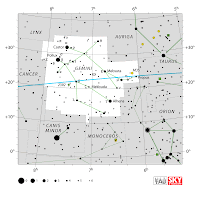
 For the first of our late winter early spring constellations let’s take a look at Gemini. The constellation is dominated by Castor and Pollux, two bright stars that appear relatively close together, encouraging the mythological link between the constellation and twin-ship. The twin to the right is Castor, whose brightest star is α Geminorum (more commonly called Castor) and the twin to the left is Pollux, whose brightest star is β Geminorum (more commonly called Pollux); the other stars can be visualized as two parallel lines descending from the two main stars, making it look like two figures. At present a further “bright star” can be found to the left of Castor & Pollux, the star is in fact the planet Mars.
Viewed with good amateur telescopes Castor can be split into three components: Castor A and Castor B revolve around each other with a period of 420 years (less good telescopes may only split Castor into two blue-white stars of 2nd and 3rd magnitude). The third component, Castor C (also known as YY Gem) circulates this pair with a period of several thousand years.
There are two double stars in Gemini that are best viewed in small telescopes, epsilon Gem and 38 Gem. The first consists of a 3rd magnitude yellow super giant with a 9th magnitude companion. The second splits into a pair of white and yellow 5th and 8th magnitude stars.
With the help of small telescopes the planetary nebula NGC 2392 reveals an 8th magnitude blue-green disk about the size of Jupiter. When viewed with larger telescopes it shows a funny shape, which is why it is named Eskimo or Clown Face Nebula.

In the next posting we’ll take a look at Cancer.


